

Every few weeks we will let you know about the latest free audio plugins. Check those expiry dates because some won’t be free forever. Join the Plugin Deals and Freebies Facebook Group, or check out r/newplugindeals and r/freeaudioplugins on Reddit if you want to find out about the latest deals and freebies as they happen.
Luna Co Audio releases free Tape Machine plugin for Windows Mac and Linux
Expiry: None
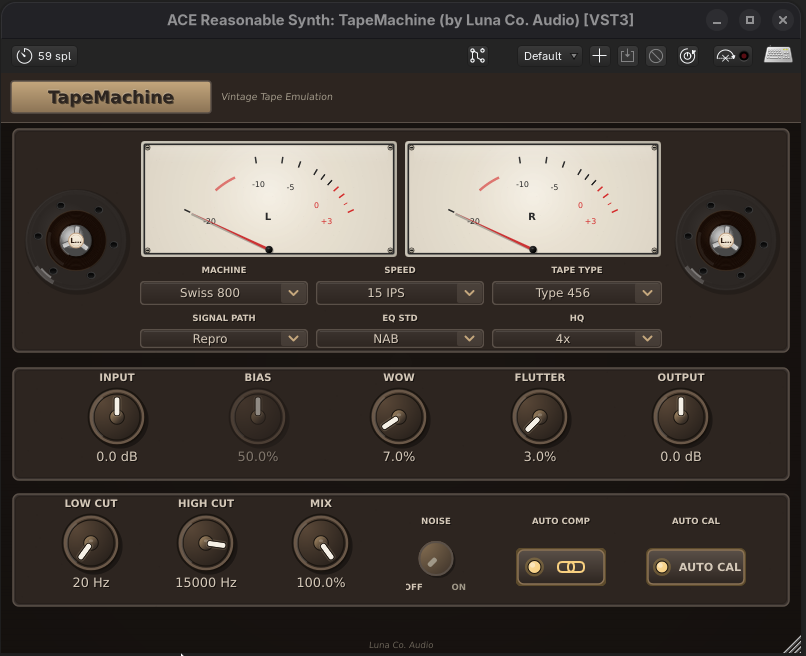
Luna Co Audio has released TapeMachine, a free analog tape emulation plugin for Windows, macOS, and Linux. Version 1.0.1 is available in VST3, LV2 (Linux), and AU (macOS) formats. The project is open source under the GPL-2.0 license.
TapeMachine models reel-to-reel behavior using a Langevin saturation function derived from Jiles–Atherton magnetic theory, calibrated against published Studer A800 and Ampex ATR-102 THD measurements. Oversampling at 2x and 4x with anti-alias filtering is included.
The plugin provides two machine models:
- Swiss800 (Studer A800 MkIII): Odd-harmonic dominant saturation (e.g., H3 around −51 dB), transformerless signal path, extended high-frequency response to about 22 kHz.
- Classic102 (Ampex ATR-102): Even/odd harmonic blend with transformer coloration, pronounced head bump around 62 Hz, high-frequency roll-off near 18 kHz.
Four tape formulations are available: Type 456, GP9, Type 911, and Type 250.
Signal path modes mirror typical tape workflows:
- Repro: Full tape processing.
- Sync: Record-head playback with additional high-frequency roll-off.
- Input: Electronics only (transformers/EQ coloration).
- Thru: Clean pass-through for comparison.
Three tape speeds are included (7.5, 15, 30 IPS), alongside NAB, CCIR, and AES equalization standards.
Separate wow and flutter controls are provided. Wow operates in the 0.3–0.8 Hz range, and flutter in the 3–7 Hz range. Random modulation is used for natural behavior, with coherent stereo processing to maintain phase alignment.
Controls and ranges:
- Input Gain: ±12 dB; Output Gain: ±12 dB
- Saturation, Bias, Wow, Flutter, Mix: 0–100%
- High-pass filter: 20–500 Hz; Low-pass filter: 3 kHz–20 kHz
Additional processing features include three-band drive ratios (bass, mid, treble), auto-compensation for unity gain across varying input levels, and auto-calibration for bias optimization.
Factory content comprises 15 presets across five categories: Subtle, Warm, Character, Lo-Fi, and Mastering.
The interface includes dual stereo VU meters (IEC 60268-17 compliant ballistics), animated tape reels, and classic-style controls.
Performance measurements at 48 kHz indicate approximately 2–4% CPU per instance with 4x oversampling, around 15 MB memory per instance, and latency of ~64 samples (2x) or ~128 samples (4x).
DAW compatibility has been fully tested with Reaper (VST3/LV2), Ardour (LV2 with full GUI), and Carla (VST3/LV2), and as a standalone application. It is expected to work in Bitwig Studio, Studio One, FL Studio, Ableton Live, Cubase/Nuendo, Logic Pro, and GarageBand (AU on macOS).
System requirements:
- Linux: glibc 2.31+ (Ubuntu 20.04+, Debian 11+, Fedora 34+)
- Windows: Windows 10 or later
- macOS: 10.13 (High Sierra) or later
- 64-bit DAW supporting VST3, LV2, or AU; sample rates 44.1–192 kHz
Plugin formats:
- Linux: VST3, LV2
- Windows: VST3
- macOS: VST3, AU
Disclaimer: TapeMachine is an independent emulation inspired by classic tape machines and is not affiliated with or endorsed by Studer, Ampex, or any hardware manufacturer.
Luna Co Audio releases MultiComp free plugin for Windows Mac and Linux
Expiry: None
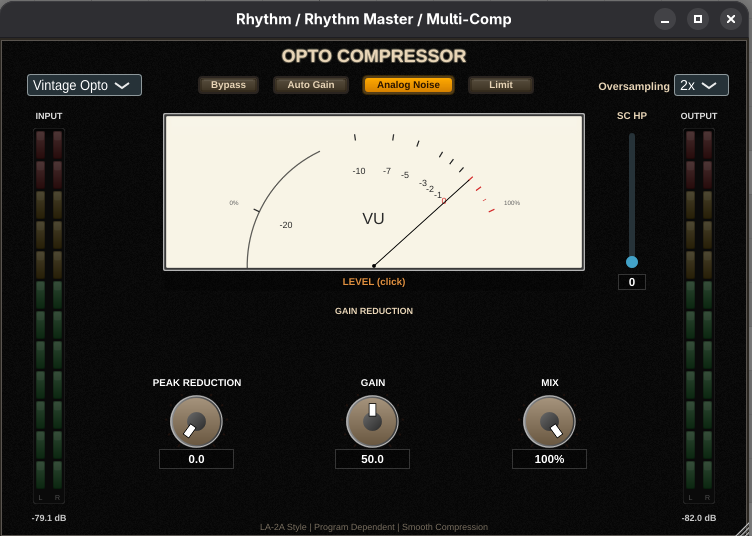
Luna Co Audio has released Multi-Comp, a free multi-mode dynamics compressor plugin for Windows, macOS, and Linux. The plugin supports VST3 and LV2 on Linux, VST3 on Windows, and VST3/AU on macOS. It is open source under the GPL-2.0 license. Version 1.2.1 is available.
Multi-Comp offers eight compression modes, each modeled after well-known workflows and response characteristics, plus a four-band multiband option:
- Vintage Opto (LA-2A style): Program-dependent attack/release, Peak Reduction control, Compress/Limit switch, and tube stage modeling. Suited for vocals and bass.
- Vintage FET (1176 Rev A style): Ratio buttons (4:1, 8:1, 12:1, 20:1), All-Buttons mode, very fast attack, and transformer saturation modeling.
- Classic VCA (dbx 160 style): Fast VCA behavior with OverEasy soft knee. Useful for drums and percussive sources.
- Bus Compressor (SSL G-Series style): Stepped attack (0.1–30 ms), stepped release with Auto, and 2:1/4:1/10:1 ratios for mix bus work.
- Studio FET (1176 Blackface style): Cleaner FET behavior with fast attack and controlled transients for modern applications.
- Studio VCA (Focusrite Red 3 style): RMS detection, optional soft knee, and low coloration for vocals and mastering.
- Digital: Transparent, peak/RMS-capable compression for precise dynamics control without added saturation.
- Multiband: Four bands with Linkwitz–Riley crossovers, per-band threshold/ratio/attack/release/makeup, per-band solo, and band meters.
Analog-style behaviors include transformer modeling, optional noise, and saturation characteristics drawn from the referenced circuits:
- Transformer modeling (input/output HF roll-off): Vintage Opto (≈18 kHz in / 16 kHz out), Vintage FET (≈20 kHz in / 22 kHz out), Bus (≈22 kHz in / 24 kHz out). VCA and Digital modes do not apply transformer filtering.
- Analog Noise toggle: adds a −80 dB noise floor; can be disabled for silent operation.
- Saturation models: Opto mode includes T4 and tube-stage behavior; FET modes model Class A transistor saturation; Bus mode adds VCA coloration. Harmonic content is derived from hardware measurements.
The plugin includes 13 factory presets covering vocals, drums, bass, guitars, mix bus, and creative use. Examples include Opto vocal leveling, FET All-Buttons room compression, VCA snare control, bus compression for mix cohesion, and multiband mastering setups.
DSP and workflow features:
- Oversampling options: Off / 2x / 4x (anti-aliasing for saturation or reduced CPU load).
- Sidechain: internal high-pass filter (20–500 Hz) and external sidechain input.
- Lookahead: 0–10 ms global buffer.
- Stereo processing with linked gain reduction.
- Mix control for parallel compression (0% dry to 100% wet), unified across all modes.
- Auto-makeup gain compensation.
- Output distortion options: Soft, Hard, or Clip.
- Full automation support.
Key parameter ranges:
- Attack: approximately 0.02 ms to 100 ms (mode dependent).
- Release: approximately 50 ms to 3 s (mode dependent).
- Ratio: 1:1 to ∞:1 (mode dependent).
- Opto Peak Reduction: 0–100%.
- Sidechain HP filter: 20–500 Hz.
- Mix: 0–100%.
Performance and compatibility:
- Typical CPU use: ~2–4% per instance at 48 kHz with 2x oversampling.
- Memory: ~15 MB per instance.
- Latency: variable based on lookahead and oversampling settings.
- Tested with Reaper (VST3/LV2), Ardour (LV2), Bitwig Studio (VST3), Carla (VST3/LV2), and as a standalone app.
- Expected to work with Studio One, FL Studio, Ableton Live, Cubase/Nuendo, Logic Pro, and GarageBand.
- Sample rates: 44.1–192 kHz.
- System requirements: Linux (glibc 2.36+ on Debian 12+/Ubuntu 22.04+/Fedora 36+), Windows 10 or later, macOS 10.13 or later; 64-bit DAW with VST3, LV2, or AU support.
Luna Co Audio launches free 4K EQ plugin for Windows Mac and Linux
Expiry: None

Luna Co Audio has released 4K‑EQ, a no-cost 4‑band console EQ plugin for Windows, macOS, and Linux. The plugin models two classic British console variants and is available in VST3, AU (macOS), and LV2 formats, plus a standalone application.
The plugin offers two operating modes that mirror E‑series and G‑series designs:
- Brown (E‑Series): broader EQ curves, gentle shelves with fixed Q, predominantly 2nd‑order harmonic content, transformer path.
- Black (G‑Series): tighter, more selective response with proportional Q, more 3rd‑order harmonic content, bell/shelf switching on LF and HF, transformerless path.
Saturation modeling is multistage and can be dialed from 0–100% via a Drive control. By default it is clean (0%).
- Input transformer coloration
- NE5534 op‑amp behavior with asymmetric soft‑clipping
- Per‑band saturation when boosting
- Output transformer harmonics (E‑Series only)
Core DSP design includes biquad IIR filters with console‑style coefficient shaping and high‑frequency pre‑warping to reduce digital cramping. Optional 2x/4x oversampling is available for anti‑aliased processing.
Primary controls and ranges:
- LF: ±20 dB, 30–480 Hz
- LMF: ±20 dB, 200–2500 Hz
- HMF: ±20 dB, 600–7000 Hz
- HF: ±20 dB, 1.5–16 kHz
- Q: 0.4–4.0 (proportional in Black mode)
- HPF: 16–350 Hz (18 dB/oct)
- LPF: 3–22 kHz (12 dB/oct)
- Saturation: 0–100%
- Output gain: ±12 dB
Feature set:
- 4‑band parametric EQ with Brown/Black modes
- High‑pass and low‑pass filters
- Bell/Shelf switching on LF and HF (Black mode)
- Analog‑style saturation with per‑band harmonics
- Auto‑gain compensation (toggle)
- M/S processing mode for mid/side workflows
- Real‑time FFT spectrum analyzer
- 2x/4x oversampling
- Mouse wheel control, double‑click reset, Cmd/Ctrl+drag fine control
- LED meters auto‑detect mono/stereo from DAW channel count
- Full automation support
Factory presets (15): Default, Vocal Presence, Kick Punch, Snare Crack, Bass Warmth, Bright Mix, Telephone EQ, Air & Silk, Mix Bus Glue, Master Sheen, Bass Guitar Polish, Drum Bus Punch, Acoustic Guitar, Piano Brilliance, Master Bus Sweetening.
Performance (48 kHz, 2x oversampling): approximately 1–2% CPU per instance, ~10 MB RAM, ~32 samples latency (about ~96 samples at 4x).
Compatibility:
- Fully tested: Reaper (VST3/LV2), Ardour (LV2 with GUI), Carla (VST3/LV2), Standalone app.
- Expected to work: Bitwig Studio, Studio One, FL Studio, Ableton Live, Cubase/Nuendo, Logic Pro, GarageBand (AU on macOS).
- Formats: Linux VST3/LV2, Windows VST3, macOS VST3/AU.
System requirements:
- Linux: Debian 12+, Ubuntu 22.04+, Fedora 36+ (glibc 2.36+)
- Windows: 10 or later
- macOS: 10.13 or later
- 64‑bit DAW supporting VST3, LV2, or AU; 44.1–192 kHz sample rates
Disclaimer: 4K‑EQ is an independent emulation inspired by classic British console EQs and is not affiliated with or endorsed by any hardware manufacturer.
GSDSP launches free version of Quantum Delay creative delay plugin
Expiry: None
GSDSP has released Quantum Delay Lite, a free edition of its creative stereo delay plugin. The full version remains available for desktop at $49.99 and on iOS at $14.99. Quantum Delay was originally released in December 2023; the current build is version 2026.0, last updated in January 2026.
Quantum Delay offers two algorithms, Tape and Fade, designed for classic and clean delay behavior. Delay time can sync to the host tempo, including uncommon divisions such as 5-tuplets, or be set freely in milliseconds. A Fine control supports micro‑timing adjustments and modulation of delay lines.
Filtering is placed in the feedback path to shape repeats. The full version provides switchable lowpass, highpass, and bandpass modes with variable slope and Q. Quantum Delay Lite includes a lowpass filter.
Feedback behavior can be governed by a traditional percentage control or a dB-per-second decay mode, which targets a consistent decay time regardless of feedback-path complexity. Additional feedback tools in the full version include Crossfeed (for ping‑pong echoes), Over‑Feedback, Feedback Kill, and Feedback Phase Invert.
The stereo architecture is configurable per section. In the full version, the Delay, Filter, and Feedback sections can each operate in stereo or dual mono, supporting tight stereo imaging or offset left/right processing. Pan and Width controls are included. Quantum Delay Lite does not include the per‑section stereo/dual mono switches, Pan, or Width.
Input routing in the full version can be set to Stereo, Left‑only, or Right‑only. This routing option is not included in the Lite edition.
The modulation system is integrated throughout the plugin and can target delay time, filter parameters, feedback settings, stereo controls, and more. Modulators provide per‑parameter depth, skew, sample & hold, and uni/bipolar modes. Available sources include standard LFOs (with a custom‑drawn LFO option), random generators, and followers such as amplitude, pitch, and spectral analyzers (e.g., brightness/centroid). Two‑dimensional modulators (LFO and Random) and dynamical systems (e.g., Lorenz attractor, double pendulum) are included. Macro controls, MIDI sources (CC, note, velocity, pitchbend, aftertouch, envelopes), and camera/sensor inputs are supported; on iOS, 3D Motion enables control via the device’s accelerometer and gyroscope. Modulators can also modulate other modulators for cross‑modulation. The modulation system is present in both the full and Lite editions.
A parameter randomisation feature allows targeted or global variation at three intensities: gentle, medium, or fully random. Users can select which parameters are affected to evolve sounds or explore new configurations.
Presets are included, with artist contributions from Cristian Vogel, DataBroth, and Zanshin. Presets created in Quantum Delay Lite can be imported into the full version.
Key parameters and features in the full version include: Tape and Fade algorithms; DAW‑sync or free delay time with Fine control; filter modes (LP/HP/BP) with variable slope/Q; feedback in % or dB/s; Crossfeed; Over‑Feedback; Feedback Kill; Feedback Phase Invert; per‑section Stereo/Dual Mono switching; Pan; Width; Dry/Wet; and input routing (Stereo/Left/Right). Quantum Delay Lite includes the same sound quality, both delay algorithms, the full modulation system, DAW sync, the lowpass filter, feedback control, and presets.
System requirements are macOS 10.13 or later, Windows 10 or later, and iOS 12 or later. Plugin formats include AU, VST3, and AAX on desktop, plus AUv3 on iOS. Desktop licensing uses a perpetual activation key; iOS licensing is via the App Store.
A free desktop trial is available for Windows and macOS. Before activation, audio will fade in and out at random intervals, and after 20 minutes the plugin mutes and must be restarted.
Infected Sounds unveils 11 free Windows only synths in 32 and 64 bit VST3 format
Expiry: None
Infected Sounds has released a collection of 11 software synthesizers for Windows, available as free downloads.
The instruments are provided in VST3 format with both 32-bit and 64-bit builds. macOS is not supported.
Each plugin functions as a VST instrument (VSTi) for compatible Windows digital audio workstations. The dual 32/64-bit availability accommodates older systems and current setups.
The set is intended for typical synthesis duties in music production and sound design, including creating basses, leads, pads, and effects within a DAW workflow.
SampleScience Releases Free Cozy Piano Virtual Instrument
Expiry: None
SampleScience has released Cozy Piano, a free multi-sampled upright piano instrument available in multiple formats, including plugin, Decent Sampler, Kontakt, Soundbox, Reason Combinator, and SFZ.
The instrument was recorded on March 17, 2025, in Thuir, France, using a Remeau upright piano placed in a spacious living room near a staircase. The session employed a Tascam FR-AV2 and a pair of Rode NT5 microphones in an XY stereo configuration. The setup was designed to capture an open, natural resonance and a coherent stereo image.
Cozy Piano is designed for quiet writing, cinematic cues, understated underscore, delicate melodies, and lofi-leaning productions.
Plugin features (VST/VST3/AU, 64-bit):
- 1 multi-sampled piano
- 4 effects: distortion, delay, chorus, and reverb
- Amplitude ADSR
- Multi-LFO
- Highpass/Lowpass filter
- Amplitude range controls
- 3 voice modes: polyphonic, monophonic, and legato
System requirements (plugin version):
- Windows 8.1/10/11 or macOS 10.14 and above
- 64-bit VST/VST3/AU host
- 2 GHz quad-core CPU or better
- 4 GB RAM or more
- 77 MB of storage
Decent Sampler version: Uses the same source samples with Decent Sampler’s effects and sound-shaping tools. Decent Sampler is available as VST/VST3/AAX/AU/AUv3 and runs on Windows, macOS, Linux, and iOS. A standalone app is also available.
Requirements (Decent Sampler):
- Latest Decent Sampler
- 68 MB of storage
Kontakt version: Includes one .nki instrument with amplitude and filter ADSR and reverb. Requires the full version of Kontakt 5/6/7 (latest update). Not compatible with the free Kontakt Player.
Requirements (Kontakt):
- Full Kontakt 5/6/7 (latest update)
- 188 MB of storage
Soundbox version: Offered for those who prefer not to install the main plugin and for Pro Tools workflows. Soundbox is available as a free VST3, AU, and AAX instrument for Windows and macOS.
Reason Combinator version: Available for Reason 12 and later, and for Reason+ subscribers.
Additional format: A GUI-less SFZ version is provided.
Note: The primary plugin version is compatible with most major DAWs except Pro Tools; Pro Tools users can use the Soundbox version.
Thanks for reading. We hope you found some cool and useful new tools!
Check out previous FREE Plugins Reports for even more freebies! You can also browse a range of free effects, free instruments, and free studio tools available from our partner Plugin Boutique, so check those out too. For everything else you can find lots of audio plugin deals on this website.